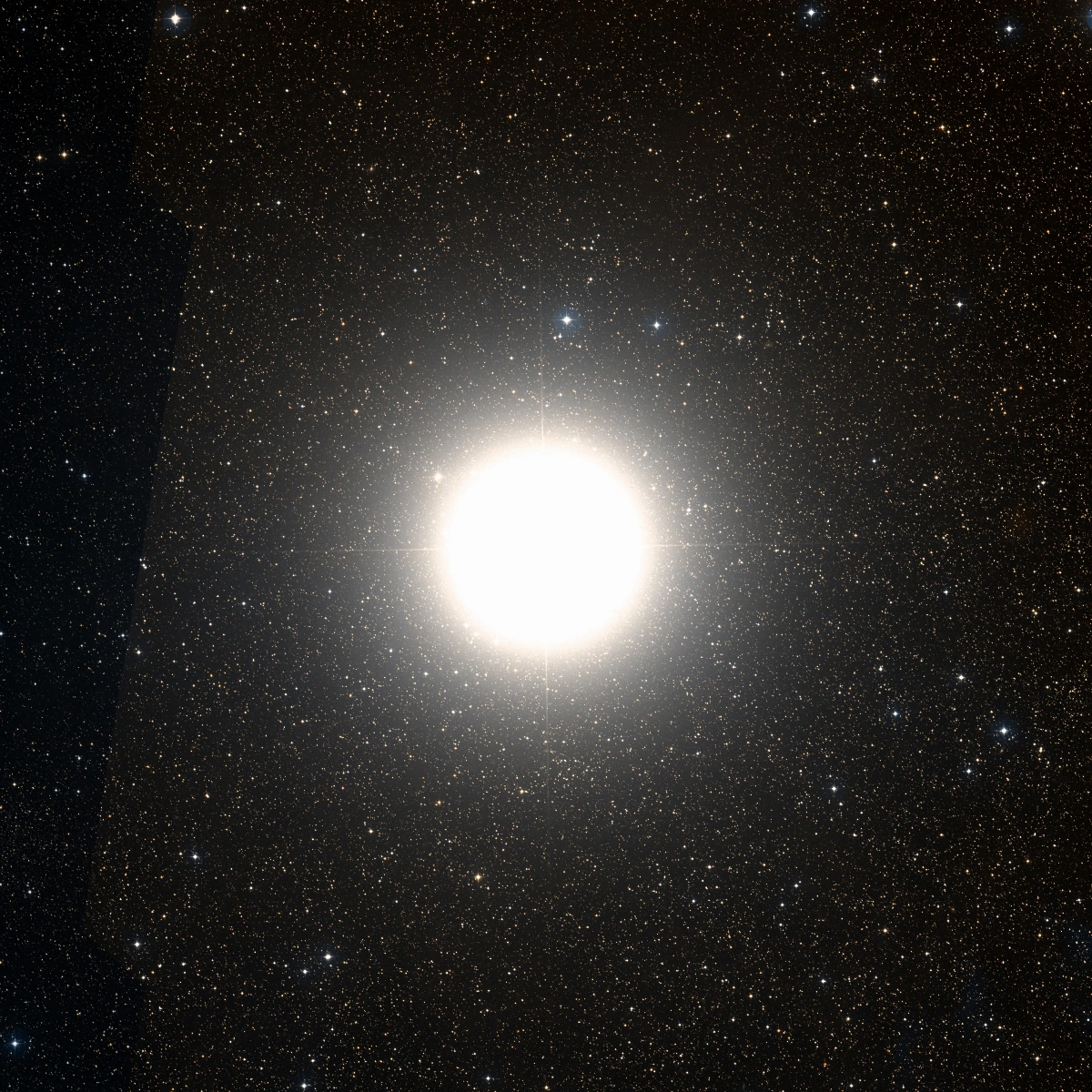
A red giant is a star in the later stages of its life — one that has exhausted the hydrogen fuel in its core and responded by expanding dramatically outward. The result is a star that can be tens to hundreds of times larger than it was in its prime, cooler at the surface, and glowing with a distinctly orange-red color. Several of the brightest stars visible tonight are red giants, and our own Sun will eventually become one.
Why Stars Become Red Giants
For most of a star's life, it exists in a state of balance. The outward pressure of nuclear fusion in the core — hydrogen fusing into helium and releasing energy — pushes against the inward pull of the star's own gravity. As long as that fuel lasts, the star stays roughly the same size. This stable phase is called the main sequence, and for a star like the Sun it lasts around ten billion years.
When the hydrogen in the core runs out, the balance breaks. The core contracts under gravity and heats up, triggering hydrogen fusion in a shell surrounding the core instead. That shell releases an enormous amount of energy — far more than the core was producing before — and the outer layers of the star respond by expanding outward. The star swells to many times its original size, and as its surface spreads over a larger area, it cools and shifts from white or yellow toward orange and red.
The result is a red giant: physically enormous, luminous, and visibly colored.
Famous Red Giants You Can See Tonight
Several of the brightest and most familiar stars in the night sky are red giants, which gives some sense of how luminous they are despite their cooler surfaces.
Arcturus is the brightest star in the northern hemisphere and the fourth brightest in the entire night sky. It's an orange giant approximately 36 light years from Earth, burning with about 170 times the Sun's luminosity. Its distinctly warm color is visible to the naked eye — look for it in the spring and summer sky by following the arc of the Big Dipper's handle outward.
Aldebaran is the bright orange star that marks the eye of Taurus the Bull. It's a red giant about 65 light years away and roughly 44 times the diameter of the Sun. Despite being much cooler than most prominent stars, its sheer size makes it one of the more luminous objects in the winter sky.
Betelgeuse sits at Orion's shoulder and is one of the largest and most famous stars visible to the naked eye. It's a red supergiant — an even more extreme version of a red giant, produced by the most massive stars — roughly 700 times the diameter of the Sun. If placed at the center of our solar system, Betelgeuse would extend past the orbit of Jupiter. It's also one of the closest stars likely to explode as a supernova in the astronomically near future, though "near" here means within the next hundred thousand years or so.
How Big Do Red Giants Get
The answer depends heavily on the mass of the original star. A star similar to the Sun will expand to somewhere between 100 and 200 times its current size — large enough to engulf Mercury and Venus. More massive stars expand even further, becoming the supergiants like Betelgeuse. The relationship between a star's original mass and its eventual size as a giant is one of the core principles of stellar evolution.
Despite their enormous size, red giants are relatively low-density objects. The outer layers have expanded so far from the core that the material there is extraordinarily thin — far less dense than Earth's atmosphere. The energy and mass are spread over a vastly larger volume.
What Happens After the Red Giant Phase
For stars similar to the Sun, the red giant phase is a transitional period that ends with the star shedding its outer layers in an expanding cloud of gas called a planetary nebula. What remains at the center is a white dwarf — a dense, Earth-sized remnant of the original core — which cools slowly over billions of years.
For more massive stars, the red or blue supergiant phase ends far more dramatically: a supernova explosion that can briefly outshine an entire galaxy, leaving behind either a neutron star or a black hole.
What This Means for Earth
In approximately five billion years, the Sun will exhaust the hydrogen in its core and begin its transition into a red giant. As it expands, it will engulf Mercury and Venus. Whether Earth survives depends on the precise rate of expansion and how much mass the Sun loses in the process — but even if Earth's orbit shifts outward enough to avoid being swallowed, the surface temperature will be far beyond anything that could support life.
Five billion years is a number that's genuinely hard to put in context. The universe itself is only about 13.8 billion years old. The Sun has been burning for 4.6 billion years and is roughly halfway through its main sequence life. There's time yet.