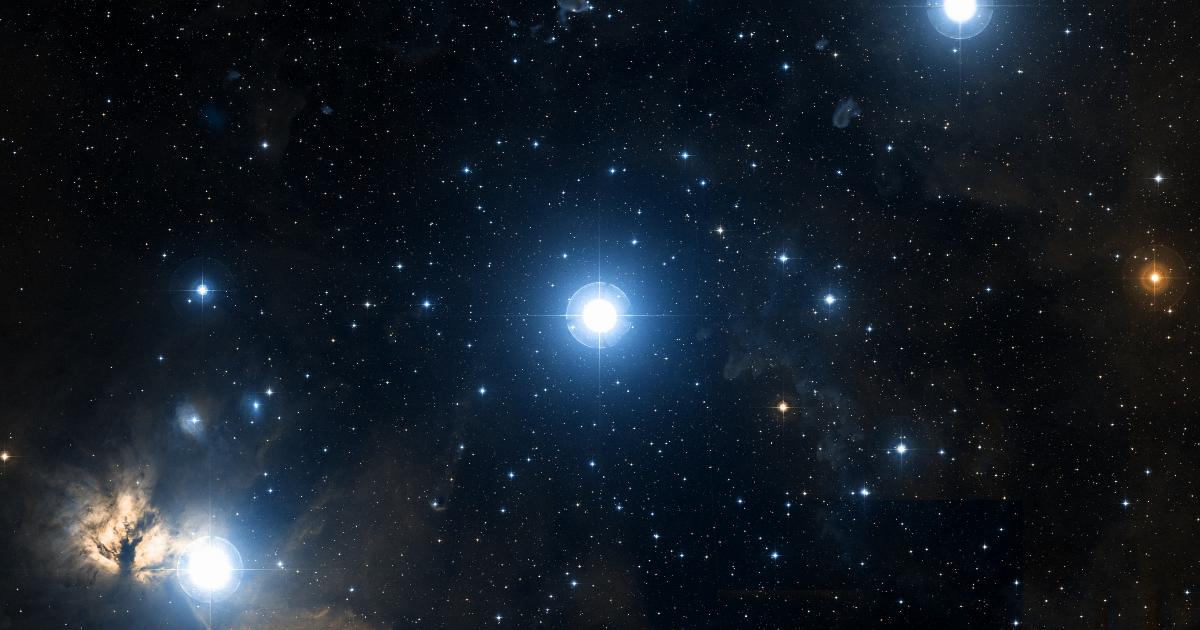
You've seen them. Three bright stars, almost perfectly spaced, lined up in a straight row in the winter sky. Maybe you noticed them from a parking lot, or through a window, or on a clear night when the sky was actually dark enough to pay attention to. They're hard to miss once you've spotted them. Here's what they are.
Those Three Stars Are Orion's Belt
The three stars in a row are Alnitak, Alnilam, and Mintaka — the three stars that form Orion's Belt, the most recognizable feature of Orion the Hunter, one of the most famous constellations in the sky. They sit almost exactly on the celestial equator, which means they're visible from virtually every location on Earth and they rise almost perfectly due east and set almost perfectly due west, every single night.
The three stars appear equally spaced because they happen to lie in nearly the same line of sight from Earth — but in reality they're nowhere near each other. Mintaka is about 900 light years away. Alnilam, the middle star, is around 2,000 light years away. Alnitak is roughly 1,200 light years out. They just happen to align from our vantage point in a way that looks deliberate.
Why They're So Easy to Spot
Three reasons. First, all three are genuinely bright — not the brightest stars in the sky, but bright enough to stand out clearly even from light-polluted areas. Second, the spacing is unusually even and the line is unusually straight, which draws the eye in a way that most star patterns don't. Third, there's nothing else in the sky quite like them — no other prominent asterism of three stars in a line competes for the same visual space.
If you see three stars in a triangle rather than a row, you're probably looking at the Summer Triangle — three bright stars from three different constellations that form a wide triangle overhead from June through October. Those are Vega, Deneb, and Altair. But if it's a line, it's Orion's Belt.
When and Where to Find Them
Orion's Belt is a winter feature in the northern hemisphere — best seen from November through March. Look south after dark and find the three evenly spaced stars in a short diagonal line. Once you have the belt, the rest of Orion opens up around it: two bright stars above the belt mark his shoulders (the distinctly reddish one is Betelgeuse, a red supergiant nearing the end of its life), and two below mark his feet. Below the belt, a faint vertical smudge is Orion's Sword — and the middle point of that smudge is the Orion Nebula, a stellar nursery where new stars are forming right now, 1,300 light years away.
Three Stars, Each One Extraordinary
Alnitak, Alnilam, and Mintaka look similar from Earth, but each one is remarkable on its own terms. All three are hot blue supergiants — stars far more massive and luminous than the Sun, burning through their fuel at a rate that means their lives are short by astronomical standards. Alnilam, the middle star, is one of the most luminous stars visible to the naked eye, shining with roughly 375,000 times the Sun's energy output. It looks like a point of light. It is anything but.
Stars like these — massive, bright, real objects at extraordinary distances — are the kind of thing the night sky is full of once you start looking. Most of them have no name beyond a catalog number.