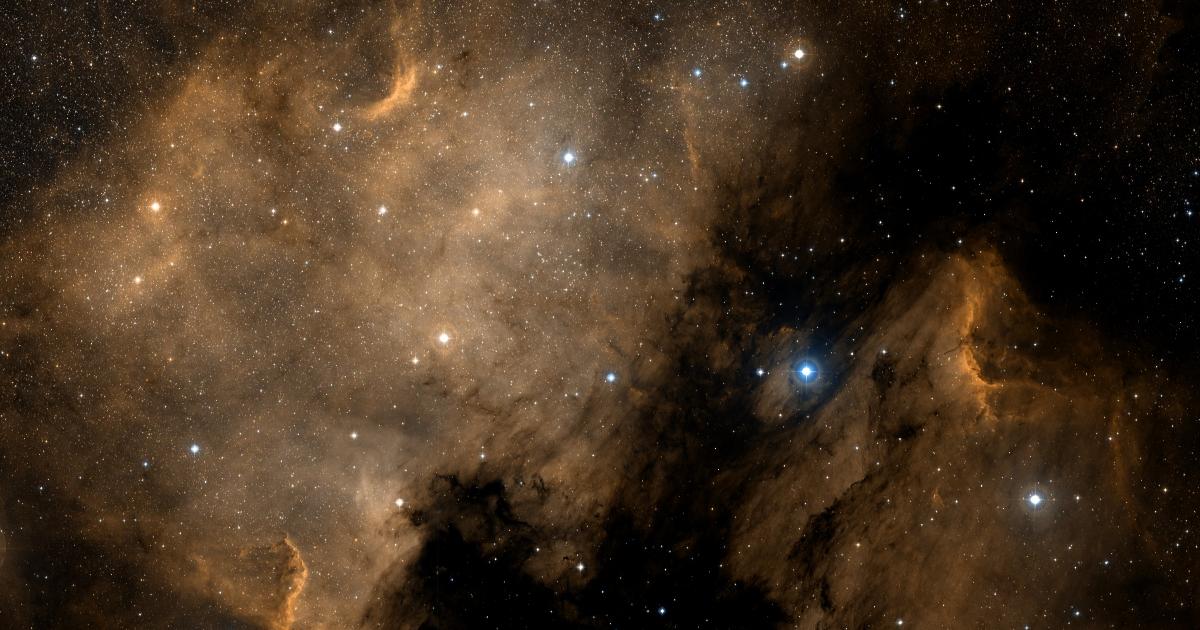
On any clear summer night, if you lie on your back and look straight up, you'll find it. Three bright stars arranged in a wide triangle, dominating the overhead sky from June through October. Astronomers call it the Summer Triangle — not a constellation, but an asterism, a pattern formed by stars that actually belong to three completely separate constellations. It's one of the easiest things to find in the summer sky, and once you know what each star is, it becomes difficult to look at them the same way again.
Vega — The Brightest of the Three
Vega is the first star of the Summer Triangle most people notice. It's the brightest of the three by a significant margin — the fifth brightest star in the entire night sky — and it sits at the northwestern corner of the triangle in the small constellation Lyra, the Harp.
At just 25 light years away, Vega is one of our closer stellar neighbors, which partly explains its brilliance. It burns blue-white, roughly twice the mass of the Sun and about 40 times more luminous, and it rotates so rapidly that its equator bulges outward — it completes a full rotation in about 12 hours compared to the Sun's 25 days.
Vega has a particular place in astronomical history. It was the first star ever photographed, in 1850, and it served as the baseline reference point for stellar magnitude — the scale astronomers use to measure brightness — for much of the 20th century. It's also the future north star. Earth's axis wobbles slowly over a 26,000-year cycle, and roughly 12,000 years from now, Vega will sit close enough to celestial north to serve as the pole star in place of Polaris.
Deneb — The Most Distant and Most Powerful
Deneb marks the tail of Cygnus the Swan and sits at the northeastern corner of the triangle. Of the three Summer Triangle stars it's the faintest to the naked eye — and yet it's by far the most extraordinary.
The reason it appears dimmer than Vega isn't because it's less luminous. It's because it's almost incomprehensibly far away. Vega is 25 light years from Earth. Deneb is somewhere between 1,400 and 2,600 light years away — estimates vary because measuring distances to supergiant stars is genuinely difficult. At that distance, appearing as bright as it does, Deneb must be producing somewhere between 100,000 and 200,000 times the Sun's total energy output.
It is one of the most luminous stars in the entire galaxy that we can see with the naked eye. If Deneb were as close to us as Vega, it would cast shadows at night and be visible in broad daylight. Instead it sits quietly at the top of the Summer Triangle, looking like just another bright star.
Altair — The Fastest Spinner
Altair marks the southern point of the triangle and belongs to Aquila, the Eagle. At 17 light years away it's the closest of the three — close enough that it has measurable proper motion across the sky, shifting its position against the background stars over human timescales.
What makes Altair unusual isn't its distance or its brightness but its rotation. Altair spins once every nine hours, fast enough that it's not even close to spherical. Its equatorial diameter is about 20 percent wider than its polar diameter — a flattening so extreme that in 2006, astronomers used an interferometer to directly image the star and confirmed it was visibly oblate. It is one of the very few stars, other than the Sun, whose surface has been directly resolved.
How to Find the Summer Triangle
From late June onward, the Summer Triangle rises in the east after sunset and climbs to nearly overhead by midnight. Vega is the bright blue-white star you'll find first — look for it high in the east as darkness falls. Once you have Vega, Deneb sits to its lower left and Altair well below and to the right, completing the triangle.
The Milky Way runs directly through the Summer Triangle, and on a dark night away from city lights you can watch it stream between Vega and Altair like a river. The dense star clouds visible in that band are looking toward the inner spiral arms of the galaxy — the Summer Triangle frames one of the best naked-eye views of our own galactic neighborhood.
Three Stars, One Sky
Vega, Deneb, and Altair have nothing to do with each other. They're nowhere near the same region of space — they're separated by hundreds of light years — and they belong to three different constellations with three separate mythologies. From Earth's vantage point, they happen to form a triangle. That accident of geometry has made them one of the most recognized star patterns in the northern sky.
That's what makes the Summer Triangle worth knowing. It's not a story the universe is telling. It's one we invented, standing on a small planet, making sense of what we could see.