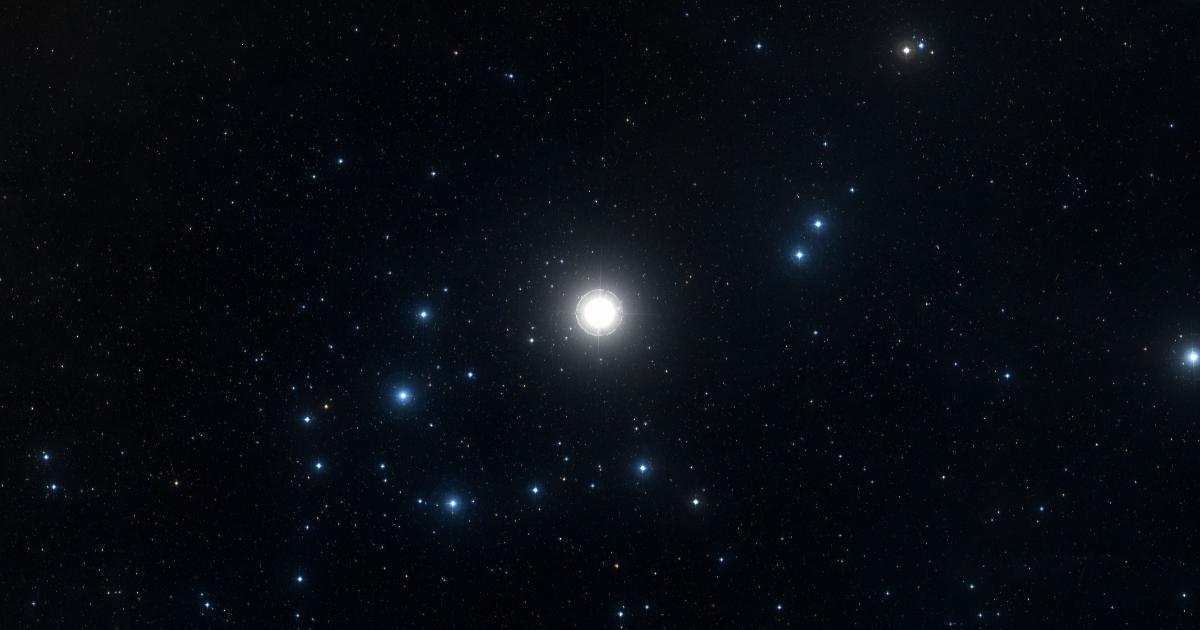
When you look at your NamedLight registry page, one of the data fields listed is your star's spectral class. It might say G2, or K5, or A1, or M3. It looks like a simple code. It isn't. That short string contains a remarkable amount of information about what your star actually is — its temperature, its color, its size, and roughly where it sits in its life.
Here's how to read it.
The Seven Spectral Types
Stars are classified into seven main spectral types, arranged from hottest to coolest: O, B, A, F, G, K, M. Astronomers use the mnemonic "Oh Be A Fine Girl/Guy, Kiss Me" to remember the order.
Each letter corresponds to a temperature range, a color, and a set of characteristics that show up in the star's light spectrum when it's analyzed through a spectrograph. Here's what each type means:
O — The Hottest Stars
O-type stars burn at surface temperatures above 30,000 Kelvin. They appear blue-white and are extraordinarily luminous — some are hundreds of thousands of times brighter than the Sun. They're also rare and short-lived, burning through their fuel in just a few million years. If your star is O-type, you have something genuinely unusual.
B — Blue-White Giants
B-type stars are still extremely hot — between 10,000 and 30,000 Kelvin — and appear blue-white. Rigel in Orion is a B-type star. They're luminous and massive, and like O-types, they live fast and die young on astronomical timescales.
A — White Stars
A-type stars burn at 7,500 to 10,000 Kelvin and appear white to slightly blue-white. Vega in Lyra and Sirius — the brightest star in the night sky — are both A-type. They're among the most visually striking stars in the sky.
F — Yellow-White Stars
F-type stars sit between 6,000 and 7,500 Kelvin. They appear yellow-white and are similar to the Sun in many ways, though hotter. Procyon, one of the brightest stars in the night sky, is an F-type star.
G — Yellow Stars
G-type stars are perhaps the most familiar class because our Sun is one. Surface temperatures range from 5,200 to 6,000 Kelvin, producing a warm yellow-white light. G-type stars are mid-sized, long-lived, and considered among the most likely to host habitable planets. If your star is G-type, it's a close cousin of the Sun.
K — Orange Stars
K-type stars are cooler than the Sun, running between 3,700 and 5,200 Kelvin, and appear distinctly orange. They're among the longest-lived stars in the galaxy — some K-type stars have been burning steadily for tens of billions of years. Arcturus, one of the brightest stars visible from Earth, is a K-type giant.
M — Red Stars
M-type stars are the coolest and by far the most common type in the galaxy. Surface temperatures below 3,700 Kelvin give them a deep red color. Most M-type stars are red dwarfs — small, dim, extremely long-lived, and slow-burning. Proxima Centauri, the nearest star to Earth after the Sun, is an M-type red dwarf.
What the Number Means
After the letter, spectral classes include a number from 0 to 9 that fine-tunes the classification within that type. A G0 star is the hottest end of the G range, closest to F-type. A G9 is the coolest end, closest to K-type. Our Sun is classified as G2 — toward the hotter end of the G range.
So if your star is listed as K4, it's a relatively cool orange star, sitting near the middle of the K range. An A1 is a very hot white star, just below the B boundary.
What It Tells You About Your Star's Life
Spectral class is closely tied to a star's lifespan. The hottest, most luminous stars — O and B types — burn through their nuclear fuel in millions of years and end in dramatic supernova explosions. Cooler stars like K and M types burn slowly and steadily for tens or even hundreds of billions of years.
A G-type star like the Sun has a lifespan of roughly 10 billion years. Our Sun is currently about halfway through that. An M-type red dwarf might burn steadily for a trillion years — far longer than the current age of the universe.
When you read your star's spectral class, you're reading a rough biography. It tells you what the star looks like, how hot it burns, how long it has lived, and how long it likely has left.
Reading Your Star's Full Data
Your NamedLight registry page lists spectral class alongside distance, apparent magnitude, right ascension, and declination. Together, these five data points give you a remarkably complete picture of your star — not just where it is, but what it is. That's the difference between a real star registration and a name attached to a coordinate.