If you've ever looked up at the winter sky and felt like you recognized something, it was probably Orion. His three-star belt is one of the most distinctive patterns in all of astronomy — visible from nearly every point on Earth, unmistakable even in light-polluted skies, and unchanged in human experience for as long as people have looked upward.
Orion is more than a landmark, though. It's one of the richest constellations in the sky — home to two of the brightest stars visible from Earth, one of the most studied nebulae in the universe, and a mythology that stretches back to ancient Greece, Egypt, and beyond.
The Mythology of Orion
In Greek mythology, Orion was the greatest hunter who ever lived — a giant of a man, son of Poseidon, who boasted he would kill every animal on Earth. The goddess Gaia, protector of the natural world, sent a scorpion to stop him. The two fought, and both were killed. Zeus placed them both in the sky on opposite sides — which is why Orion sets in the west just as Scorpius rises in the east. They never share the sky at the same time.
Other cultures saw different things in the same stars. The ancient Egyptians associated Orion with Osiris, god of the afterlife and rebirth. The Babylonians called him the Heavenly Shepherd. The Japanese called the belt stars the Three Sisters. Across cultures and centuries, the same three stars have meant something — which is itself a remarkable thing.
Finding Orion in the Night Sky
Orion is a winter constellation in the northern hemisphere, best seen from November through March. He rises in the east after sunset and moves across the southern sky through the night.
The easiest way to find him is to look for the belt — three bright stars in a nearly perfect straight line, equally spaced, sitting in the middle of the constellation. Once you have the belt, everything else falls into place:
- Above and to the right is Betelgeuse — a distinctly orange-red star marking his right shoulder
- Below and to the left is Rigel — a brilliant blue-white star marking his left foot
- Below the belt, a faint smudge marks the Orion Nebula — visible to the naked eye on a clear night
Orion is also one of the few constellations visible from both hemispheres. In the southern hemisphere he appears upside down and higher in the northern part of the sky, but the belt remains unmistakable.
The Stars of Orion
Betelgeuse
Betelgeuse is one of the largest and most luminous stars known — a red supergiant so enormous that if it replaced the Sun at the center of our solar system, its surface would extend past the orbit of Jupiter. It sits approximately 700 light years from Earth, meaning the light you see tonight left the star around 1300 CE.
Betelgeuse is also a dying star. It will end its life in a supernova explosion at some point in the astronomically near future — likely within the next 100,000 years. When it does, it will briefly be visible in daylight. In 2019 and 2020 it dimmed dramatically, briefly sparking speculation that the end was near. It wasn't — but the episode reminded astronomers how closely this star is being watched.
Rigel
Rigel is the brightest star in Orion and the seventh brightest in the night sky. It's a blue supergiant approximately 860 light years away, burning at roughly 120,000 times the luminosity of the Sun. Despite being designated Beta Orionis — the second letter of the Greek alphabet, traditionally given to a constellation's second-brightest star — Rigel is almost always brighter than Betelgeuse, whose variability occasionally tips the balance.
Bellatrix
Marking Orion's left shoulder, Bellatrix is the third brightest star in the constellation and the 27th brightest in the night sky. Its name means "female warrior" in Latin. It's a hot blue giant, much younger than our Sun, burning through its fuel at a rate that means its life will be relatively short on astronomical timescales.
The Belt: Alnitak, Alnilam, and Mintaka
The three belt stars are each remarkable in their own right. All three are hot blue supergiants many times larger and more luminous than the Sun, lying between 800 and 1,300 light years away. Alnilam, the middle star, is one of the most luminous stars visible to the naked eye. Together, they form one of the most iconic straight lines in the sky — a coincidence of perspective that has guided navigators, inspired mythology, and oriented humans in the dark for thousands of years.
The Orion Nebula
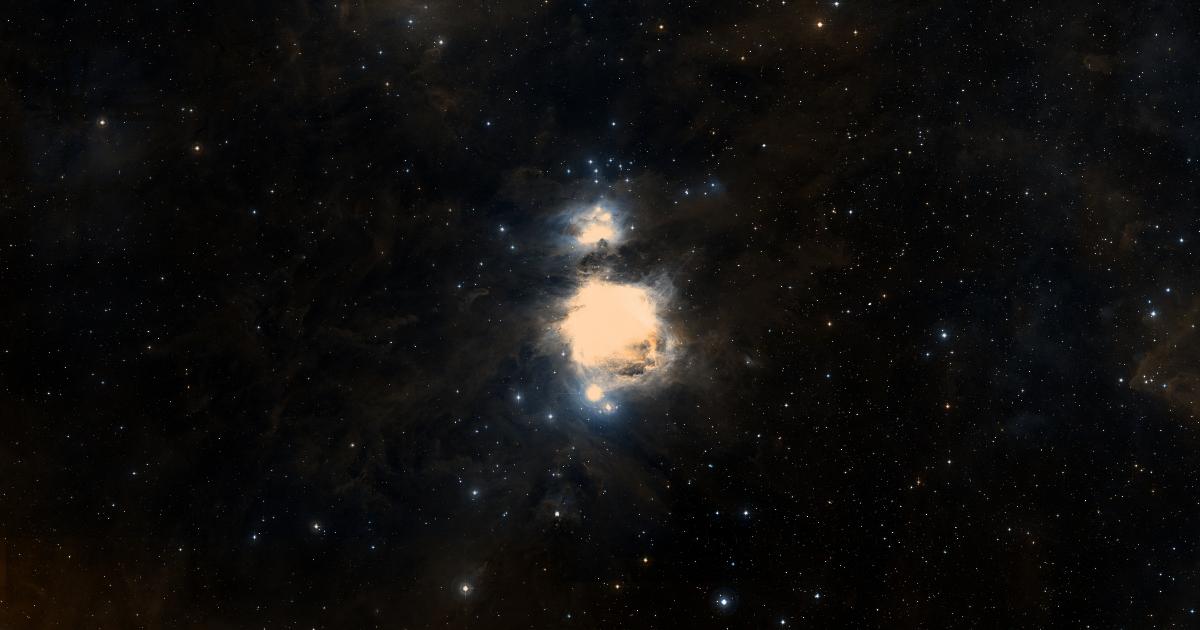
Below the belt, in what astronomers call the sword of Orion, lies M42 — the Orion Nebula. It is a stellar nursery: a vast cloud of gas and dust roughly 1,344 light years away, actively forming new stars. On a clear dark night it's visible to the naked eye as a faint smudge. Through binoculars it reveals structure. Through even a modest telescope it becomes one of the most beautiful objects in the sky.
The Orion Nebula is one of the most studied objects in all of astronomy, partly because of its proximity and partly because of what it shows us: star formation in progress, the birth of solar systems, the beginning of the cycle that eventually produces planets and, possibly, life.
Orion at a Glance
Abbreviation - Ori
Genitive - Orionis
Brightest star - Rigel (β Orionis)
Best visibility - January, northern hemisphere
Notable objects - Betelgeuse, Rigel, Orion Nebula (M42), Horsehead Nebula
Associated myth - The Hunter, son of Poseidon
A Constellation That Belongs to Everyone
What makes Orion different from most constellations is how democratic it is. You don't need dark skies. You don't need a telescope. You don't need to know anything about astronomy. You just need to look up on a clear winter night and find the belt. Everything else follows.
That accessibility is part of why naming a star within Orion carries particular weight — it's a constellation people will actually find, will actually look at, and will actually be able to point to and say: there.